Telegram Growth — The Complete Guide
How Telegram channels and groups actually grow, what members, views and reactions really are, and why growth advice imported from Instagram does not survive the trip.
Telegram is the odd one out among large social platforms. It has no recommendation feed deciding whose post you see and no advertising auction quietly ranking content behind the scenes. What it has instead is a subscription model: people join a channel, and then they see everything that channel posts, in order, until they leave. Telegram does recommend channels — its documented similar-channels feature ranks them by overlap between subscriber bases — but nothing recommends an individual post.
That single design decision changes what “growth” means. On Instagram or TikTok, a small account can reach a million people because a recommendation system decided to test the post. On Telegram, that cannot happen. Your reach is bounded by your subscriber list, and the only way to reach more people is to get more of them onto that list — or to get your message forwarded onto someone else’s.
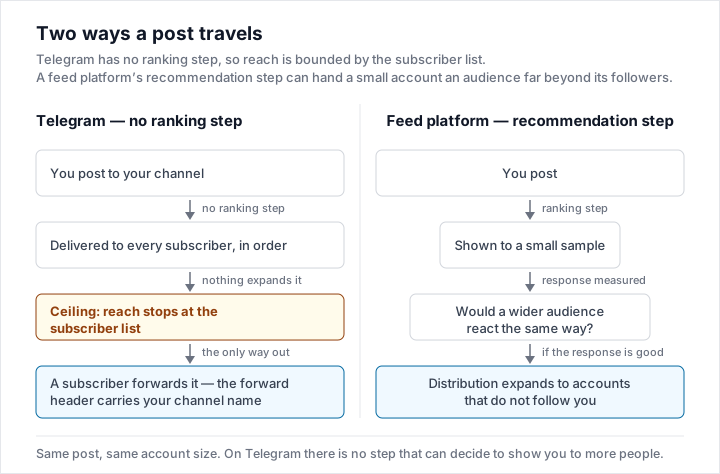
This guide covers how that works, what the numbers on your channel actually measure, why so much published advice about Telegram was written for a different platform, and how the market for paid Telegram growth operates. It is the entry point to everything else we have written about Telegram; each section links to a longer treatment.
How Telegram distribution actually works
When you post to a channel, Telegram delivers that post to every subscriber. No ranking step decides which of them are eligible to see it. A channel with 10,000 subscribers puts its post in front of 10,000 chat lists, and the only question is how many of those people open it.
This makes Telegram unusually predictable and unusually unforgiving. Predictable, because your reach does not swing wildly based on decisions you cannot observe. Unforgiving, because there is no mechanism that will discover you. Nobody stumbles onto a Telegram channel the way they stumble onto a TikTok video.
People find channels in five ways, and it is worth being precise about them because every growth tactic is a variation on one of these:
- A forward. Someone shares your post into another chat, and the forward header carries your channel name. This is the closest thing Telegram has to organic virality.
- A mention or link in another channel, a group, or a website.
- Telegram search. People search the app for a keyword, and channel names and descriptions are matched against it. Weakly, but they are matched. What can and cannot be influenced there is covered in how to grow a Telegram channel.
- External discovery — a directory site, a Google result, a link in a bio somewhere else.
- Paid placement — either Telegram’s own ad platform, or a paid post in someone else’s channel.
Notice what is absent: there is no “For You”. If your channel is not being forwarded, mentioned or advertised, it is not growing.
How firmly can anyone say no algorithm ranks your posts?
Everything above is an assertion that a mechanism does not exist, which deserves more care than an assertion that one does. This is what it rests on, so you can judge it yourself.
Telegram has never published ranking documentation. There is no counterpart to Google’s search guidance or to Meta’s periodic explanations of how a feed is ordered — no signals, no weightings, no eligibility rules for a channel post. Its client protocol is public in full, and there is no call in it that asks a server which subscribers ought to receive a post. Delivery is the default, and the protocol treats that as unremarkable enough not to discuss.
The one recommendation surface Telegram does document is instructive precisely because of how narrow it is. The similar-channels reference describes an endpoint that returns “a list of similarly themed public channels and bots, selected based on similarities in their subscriber bases”, offered when somebody joins a channel or opens the similar-channels tab on a profile. The selection input named there is audience overlap. Engagement is not mentioned, and neither is recency, keyword matching, or anything else a publisher changes by writing differently.
So the accurate form of the claim is this. Telegram documents no mechanism that ranks or rations posts, and the single discovery mechanism it does document runs on who your subscribers are rather than on how they behave. Whether some undocumented weighting exists somewhere is not something anyone outside Telegram can confirm, and we are not going to pretend otherwise. What can be said is that nothing in the published platform gives engagement a route to reach — so anyone selling you one is describing a mechanism that has never been shown to exist, and the burden of proof sits with them.
One reflex worth resisting: reading “no ranking system” as “small platform”. Telegram’s advertising guidelines put the scale plainly — “every month, 1 billion Telegram users generate 1 trillion views in public broadcast channels”, per the Telegram Ads guidelines. All of that distribution happens without a single decision about which post reaches whom. The absence is an architectural choice operating at enormous scale, not an unfinished product.
What this breaks in advice imported from Instagram
A great deal of published Telegram guidance is Instagram guidance with the nouns replaced, and it fails in a specific, predictable way: every claim in it depends on the step Telegram does not have. Four of them are worth naming, because they are the four you will meet first.
“Engagement increases reach.” There is no reach decision available for engagement to influence. A post with four thousand reactions and a post with none are delivered to exactly the same accounts. Reactions do useful work, covered further down this page, but distribution is not the work they do.
“Post at the optimal time or the algorithm buries you.” Nothing buries anything. Timing decides where your post sits in somebody’s chat list when they next open the app — a real effect, and a much gentler one, which never causes a post to fail permanently. Best times to post covers how to find your own window and why published charts cannot.
“Hashtags help people find you.” This one needs correcting rather than repeating, including by us: Telegram does run a global search across the posts and hashtags of public channels, so a tag on a public post is reachable from outside the channel. What keeps it from being a discovery route is the meter — the search is a paid Premium feature. The full surface is in how to grow a Telegram channel.
“Consistency trains the algorithm.” Consistency matters a great deal, for an entirely human reason: people form the habit of checking a channel that is reliably there. No system is being trained.
Plenty does transfer, and it is worth saying which parts, because “Telegram is different” gets overstated in the other direction too. Posts that stand on their own travel further. Audiences leave when the subject drifts or the posting rate climbs past their tolerance. A visitor’s judgement about whether an account is worth their attention is made on visible numbers in a couple of seconds. And a purchased metric buys an appearance rather than an audience — for reasons that differ by platform, worked through in members explained.
One question sorts any claim you read about this platform: does it depend on a system deciding who sees your posts? If it does, it was written for somewhere else. If it is about what makes a person forward something, join a channel, or stay subscribed, it probably survives the trip.
The same words mean different things on each platform
Beyond the tactics, the vocabulary is shared and the definitions are not, which produces genuinely misleading comparisons — usually in favour of whoever is drawing them.
Reach. Meta defines this one precisely: in the Instagram Insights API reference it is “the number of unique accounts that have seen your content, at least once, including in ads”. Unique accounts, paid delivery included. It is the outcome of a decision — how many accounts the system chose to show the post to. Telegram makes no such decision, so the nearest equivalent quantity is simply your subscriber count. Putting an Instagram reach figure beside a Telegram view count sets a distribution outcome against a delivery count. A related trap for anyone reading older explainers: the reach-versus-impressions distinction half the internet still teaches describes a metric Meta has retired, deprecated across all API versions on 21 April 2025.
Views. Meta’s definition is broad — the same reference gives views as “the number of times your content was played or displayed”, with no minimum duration stated anywhere on the page. Telegram’s is unusually specific, because the counting rule lives in the client protocol rather than in marketing copy: the counter is queued “when the bottom edge of the message becomes visible” for a message the account has not read, and when its vertical centre becomes visible for one it has already read, per the view-counter specification. That is a rule about what arrived on a screen, not about what was read. What loosens it further is time — Telegram’s channel FAQ says that “after a short while (around 4 days), Telegram will forget that you’ve seen a post and will count you again”. Post views explained works through both properties and what they do to a week-old number.
Engagement rate. The thing worth knowing is that Meta does not publish one. There is no official Instagram engagement-rate metric and no official formula; what Meta exposes are primitives — accounts engaged, total interactions, likes, comments, shares, saves. Every percentage you have read was computed by whoever quoted it, from a denominator they chose, which is why two tools reporting on one account disagree. Attribute the formula to its author, never to the platform. Telegram’s analogue, views over subscribers, is at least built from two quantities the platform itself reports — and it still feeds nothing automated. It is a human-readable health signal, which is why it matters commercially rather than algorithmically.
Followers and subscribers. An Instagram follower is eligible to be shown your posts. A Telegram subscriber will be shown them. That is a categorical difference rather than a matter of degree, and it is why a Telegram subscriber is worth more per head — and why inflating the count damages a more meaningful ratio.
What the numbers on your channel mean
Telegram gives you three headline numbers, and all three are routinely misread.
Subscribers
The subscriber count is the number of accounts currently subscribed. It is not the number of people who will see your next post — some of those accounts are dormant, some are deleted but not yet purged, and some belong to people who have muted you and will never open the chat again.
The count also moves down on its own. Accounts get deleted, people clean up their chat lists, and Telegram periodically removes deactivated accounts in bulk. A channel that is not adding subscribers is losing them. This is normal, and reviving an inactive channel covers how to tell that housekeeping apart from readers walking away.
Views
The view counter under a post is the more useful number, and the more misunderstood one. A view is counted once the message has scrolled fully into view — which is a fact about what was on a screen, not about whether anyone took it in. Views also accumulate over time rather than arriving at once, and they include views from forwards into other chats.
What views are genuinely good for is the ratio. Views divided by subscribers tells you what proportion of your list is still paying attention, and that number is the single most honest metric a Telegram channel has. See post views and the statistics panel for how to read it and what Telegram reports alongside it. What it cannot tell you is who looked: Telegram keeps a list of viewers for small groups, private chats and stories, never for a channel post, and the surface-by-surface answer sets out the limits of each.
That claim used to come with an invented example. It now comes with a measurement: we read 430 public channels three times over six hours on 9 September 2026 and found the median channel gets 0.17 views per subscriber on a typical post — and that the figure falls hard with size, from 1.38 in the smallest tenth of channels to 0.02 in the largest. So a 50,000-subscriber channel at 1,500 views per post is at 0.03, which is ordinary for that size rather than the emergency the older wording implied. What a post’s view count actually does sets out the distribution, how a post fills up hour by hour, and why 82% of channels have an older post with more views than their newest.
“Views accumulate over time” turns out to mean days rather than hours, which matters for anyone judging a post. We read the same posts again on 13 September, a median of 97 hours after the first reading: a post that had been 12 to 24 hours old was carrying about half of the views it showed four days later, and one that had been a day or two old about two thirds. Posts one to two weeks old were still gaining a median of 11.2% across those four days, and only posts already older than a month had genuinely stopped. That follow-up reading only keeps channels whose posts were still in the preview four days on — 244 of the 325, posting a median of 0.43 times a day — so it describes quieter channels rather than busy ones. The practical consequence is the same either way: compare posts at the same age, because a fresh post measured against a settled one is being judged against a number it has not had time to reach.
The same dataset answers the two questions channel owners ask next, within the limits of a one-night reading: how often to post, where busier channels draw fewer views per subscriber even among channels of the same size, and whether a photo beats a text post, where inside the same channel the edge is about 3%, too small to see on any one channel.
Reactions
Telegram added emoji reactions in 2022 and they look, at a glance, like a like button: a row of emoji under a post, a count beside each, a tap to add yours. The resemblance is why they are the most over-claimed feature on the platform — but the section above has already disposed of the reach argument, so what is left is the part nobody writes about, which is what they are actually for.
Start with what Telegram exposes, because the protocol draws one line very clearly. The reactions reference documents that in groups the reaction list can be fetched “along with the sender of each reaction”, gated behind a visibility flag, and provides no equivalent for broadcast channels. Attributable in groups, aggregate in channels, at any size — that is documented behaviour rather than an observation, and no growth threshold changes it. The available-reaction record also carries a Premium flag, and Telegram lists “Unique Reactions” among the things a subscription unlocks (Telegram Premium FAQ). One qualifier that gets left out: the same FAQ says a non-subscriber can add a premium reaction once a subscriber has used it on that message. So an unusual emoji means a Premium account put it there first, not that every account showing it is Premium.
Telegram also sells reactions itself, which almost nobody writing about buying them mentions. A paid reaction is sent with Stars, transfers those Stars “to the channel’s balance”, and increments the counter by the amount sent; the sender may stay anonymous or appear as a channel they own. Two consequences. On a channel with the feature enabled, part of the reaction count is a payment rather than an opinion, which matters when you are reading somebody else’s numbers as sentiment. And this is the one form of paid reaction where the money reaches the channel instead of a reseller.
What reactions are genuinely good for is feedback, and it is underrated because it is unglamorous. Views tell you a post was displayed; a reaction tells you somebody had an opinion, which is a different class of information. The mix carries more than the count — 200 approving taps is a different result from 90 approving and 110 disapproving — so a channel that removes every negative option has traded its only free sentiment survey for a flattering number. Read the result as a rate against views rather than as a total: Telegram’s statistics return reactions per post beside views per post, and dividing one by the other gives it directly. A channel whose views hold steady while its reaction rate falls is drifting toward dormancy — people still open it out of habit, and nothing lands.
Which is also the case against buying them. Purchased reactions destroy the only cheap signal Telegram gives a publisher, and they are visible to anyone who looks: reaction counts that run close to the view count describe an audience that reacts to nearly everything, an exactly even split across six emoji is not a pattern people produce, and one heavily reacted post among posts with none is the same tell as an isolated view spike.
Channel or group?
These are different products, and choosing the wrong one is expensive to reverse because migrating means asking your audience to move. The short version: a channel broadcasts and holds up at any size; a group converses and becomes unusable noise somewhere past a few hundred active people. If the value you offer is your own output, you want a channel. If the value is people talking to each other, you want a group, and probably a smaller one than you think. The full comparison — including why a supergroup is technically a channel wearing a flag, and the hybrid setup most large projects end up with — is in how to grow a Telegram channel.
Growing without paying for it
The organic tactics that work on Telegram are unglamorous and mostly come down to being findable and being worth forwarding.
- Post something that survives a forward. A forwarded post arrives in a chat with no context. If it only makes sense to people who already follow you, it converts nobody.
- Cross-promote with channels of similar size. Two channels of 5,000 each swapping mentions is the most reliable growth mechanic on the platform, and it costs nothing but a conversation. It is also the only tactic that feeds Telegram’s own recommender, since that runs on shared subscribers.
- Be findable in search. Your channel name and description are the only text Telegram matches on for free. A channel called “Updates” is invisible.
- Link from outside. Telegram links work everywhere. A
t.melink in a website footer, a video description or a bio will out-perform anything you do inside the app if you have any audience elsewhere. - Post at a consistent time. Not because an algorithm rewards it — nothing ranks the post you publish — but because chat lists are ordered by recency and people check in patterns. See best times to post.
If you are starting from nothing, the structured version of all of this, week by week, is in how to grow a Telegram channel from zero.
The market for paid Telegram growth
There is a substantial market in Telegram services — members, views, reactions, bot starts — sold through what the industry calls SMM panels. It is worth understanding what is actually on offer, whether or not you intend to buy any of it, because the terminology is deliberately imprecise and the same words mean different things at different vendors.
What is sold, what it delivers, and what it cannot do
Every panel sells roughly the same eight things under slightly different names. The table below is built the way a buyer needs it rather than the way a catalogue presents it: not the marketing description, but what each service actually changes on your channel, what it demonstrably does not change, and roughly where it sits on price relative to the others.
We are deliberately not printing per-unit prices. They move constantly, they differ by an order of magnitude between vendors for the same nominal product, and any number written here would be wrong within a month. What is stable is the ordering — which services are cheap and which are expensive relative to each other — and that ordering tells you most of what you need before you look at a live catalogue.
| Service | What actually changes | What it does not do | Relative price | Detail |
|---|---|---|---|---|
| Channel members | Your subscriber count. Accounts appear on the member list. | Does not move your view count, so it pushes your view-to-subscriber ratio down. | Low to mid, depending on tier | Members explained |
| Premium members | Subscriber count, plus a member list that survives inspection, plus boost eligibility. | Does not make anyone read your posts. The badge is the product. | Highest, by a wide margin | Premium members |
| Post views | The view number under one specific post you nominate. | Does not affect distribution — Telegram has no per-post ranking for a view count to feed. | Lowest per unit | Post views |
| Auto views | Views applied automatically to posts you have not published yet. | Same as above, and it keeps running whether or not the post deserved it. | Low, sold as a subscription | Auto views |
| Reactions | Emoji counts under a post. | Nothing structural, and it costs you the only free sentiment signal you had. | Low | Reactions, above |
| Bot starts | Real, addressable users in your bot who you can message directly, forever. | Purchased starts never respond, which removes the only thing that made a start valuable. | Mid to high | Bot starts |
| Country-targeted members | Members the vendor claims are in a specific country. | The targeting is the hardest claim in this market to verify from outside. | Premium over standard members | Targeted members |
| Story boosts | Boost level on your channel, which unlocks Telegram features for you. | Expires when the underlying subscription does — you are renting, not buying. | High, and recurring | Stories and boosts |
Which of these fits which problem
Most people arrive at a panel with a goal rather than a product in mind, and the mapping is not obvious from the listings. Three cases cover almost all of it.
- You need the channel to look established before a specific conversation — a cross-promotion, an advertiser, a partner who will glance at your numbers once. This is the only case where paid members do the job they are sold for, and it is the case where the ratio matters most: buy members without views and the person you are trying to impress sees exactly what happened.
- You want more people actually reading — no service on any panel does this. Not one. Reading requires distribution, and on Telegram distribution comes from forwards, cross-promotion and the channels your audience already reads. Growing a channel from zero covers what does work.
- You want a list you can contact directly — that is a bot, and it is the one asset on Telegram that behaves like an email list. Paying for starts defeats it, because the value was never the number.
What the vocabulary hides
Three words do most of the work in this market — “real”, “active” and “guaranteed” — and none of them is defined consistently, or means what a buyer assumes. Read carefully, most listings are honest in a narrow technical sense and misleading in every practical one. Members explained takes each tier apart and says what is actually being delivered; our buyer’s guide sets out what can be checked about a seller before you pay them.
The risks, stated plainly
Telegram’s Terms of Service prohibit spam and bulk automated activity. Enforcement is real but opaque, and nobody outside Telegram knows the thresholds. What can be said honestly:
- Channels do get restricted, most often for reported content rather than for subscriber counts.
- A sudden jump from 200 to 50,000 subscribers is visible to anyone who looks at your channel and looks exactly like what it is.
- Bought members almost always dilute your view-to-subscriber ratio, which is the metric advertisers and partners look at. A channel that buys 40,000 members and keeps 1,200 views has made itself less sellable, not more.
- Money spent is not recoverable if the provider disappears, and providers in this market disappear regularly.
Does buying members get your channel restricted? covers what Telegram’s rules actually say — which is less than both sides of that argument assume — and avoiding Telegram scams covers the outright fraud that surrounds this market.
Premium, Stories and Boosts
Telegram has added a subscription tier and a set of features that sit on top of it. For channel owners the practical effects are modest but worth knowing: Premium members can boost your channel, boosted channels unlock Stories and other features, and Premium accounts are visually distinguishable. See what Premium changes for channel owners and Stories and Boosts.
Where to go next
If you are new to this, read how to grow a Telegram channel from zero first, then what the view counter measures and what the statistics panel adds.
If you are considering buying anything, read members explained before you spend money.
If your channel has stalled, start with reviving an inactive channel, which covers both why the numbers fell and the way back.
The equivalent guide for Instagram, YouTube and TikTok is social media growth.
Frequently asked questions
How many subscribers does a Telegram channel need to be worth anything?
There is no threshold. What matters is the view-to-subscriber ratio and whether the audience is the right one. A 3,000-subscriber channel with 2,000 views per post is a genuinely valuable asset; a 100,000-subscriber channel with 1,500 views is a liability that costs money to maintain.
Does Telegram have an algorithm I can optimise for?
No. Posts are delivered to every subscriber in order, and no ranking step decides which of them sees it. Telegram does rank channels in its similar-channels recommendations, on overlap between subscriber bases rather than on anything in a post — so the lever there is who else your subscribers follow, not how a post is written. Search matching on channel names and descriptions is the only other thing that resembles ranking, and it is crude.
Do Telegram reactions increase reach?
Nothing Telegram documents gives them a route to. Every post already reaches every subscriber, the reactions specification says nothing about distribution, and the one recommendation surface Telegram documents selects channels by subscriber overlap. This is genuinely different from Instagram or TikTok, where engagement does drive reach and the platforms say so themselves.
What are Telegram’s paid reactions?
A reaction sent with Telegram Stars, which transfers those Stars to the channel’s balance and increments the counter by the amount sent. Senders can stay anonymous or appear as a channel they own. It is the one form of paid reaction where the money reaches the channel rather than a reseller — and it still does nothing for distribution.
Why did my subscriber count drop overnight without me doing anything?
Almost always because Telegram purged deactivated accounts. Accounts that have been inactive for a long period are removed, and those removals show up as a sudden drop across many channels at once. It is not a penalty.
Is buying Telegram members against the rules?
Telegram’s terms prohibit spam and bulk automated activity, and say nothing specific about subscriber counts. The clearer risk is not enforcement but dilution — you damage the ratio that makes a channel worth advertising in.
Disclosure: Novamya is published by Utta, which also builds and maintains websites for SMMLaunch and AdderPanel. Links to those panels are marked as sponsored. We do not accept payment for coverage or ratings — how this works.