What “Start Bot” Means on Telegram (and When Starts Are Worth It)
A bot start is the one Telegram metric that can carry real intent — and the one where purchased volume is most obviously worthless.
A bot start is what happens when someone presses the Start button on a Telegram bot for the first time. It is a small event with an unusual property: it is the only interaction on Telegram that reliably creates a persistent, addressable relationship between you and an individual user.
That makes it the most valuable metric on the platform and the one where purchased volume is most obviously pointless — for reasons that become clear once you see what a start actually gives you.
What “start bot” means on Telegram
“Start bot” means pressing the Start button on a Telegram bot, an automated account you talk to in an ordinary chat window, for the first time. That press is what gives the bot permission to message you — before it, the bot cannot reach you at all. On the bot owner’s side it registers as a start, and it is the only Telegram event that opens a direct line to an individual person.
What a start actually does
Before a user presses Start, a bot cannot message them at all. Telegram’s bot platform is opt-in by design: the user initiates, and only then does the bot gain permission to send.
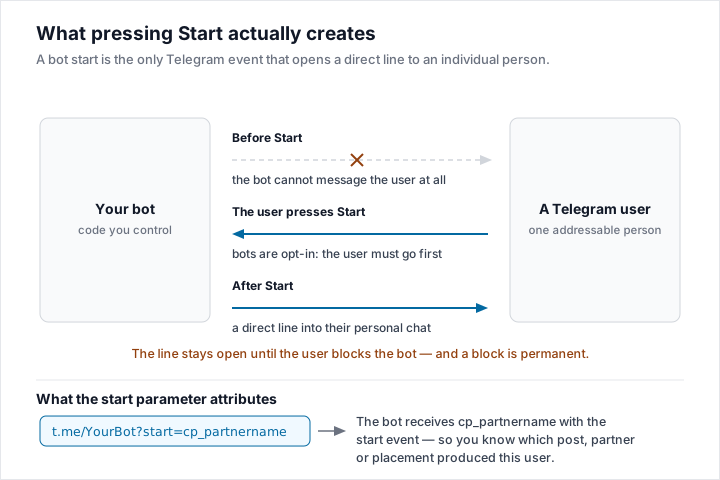
Once that happens, three things become true:
- You can message that person directly. Not a broadcast to a channel — a message in their personal chat list, indefinitely, until they block the bot.
- You know who they are, as an ID. Not a phone number, but a stable identifier you can attach records to, alongside whatever name the person has set.
- You can treat them differently from everyone else. Segment, sequence, personalise, respond to what they did.
From the user’s side, that is also the extent of what a start hands over: the bot gets your user ID, the name and username on your profile and the right to message you, not your phone number unless you choose to share it. The risk lies in what a bot asks for next; treat a request for a phone number, a payment or a login as you would on any website.
Compare that to a channel subscriber, who is an anonymous entry in a count you can only broadcast to. The difference is roughly the difference between a mailing list and a billboard.
The start parameter, and why it matters
This is the part most channel owners have never used and should.
A bot link can carry a parameter: t.me/YourBot?start=whatever. When the user presses Start, the bot receives whatever along with the start event.
That single feature makes bot starts the only clean attribution mechanism on Telegram. Put a different parameter in each place you post a link and you learn exactly which one worked:
?start=ch_mainin your channel?start=cp_partnernamein a cross-promotion?start=ad_janin a paid placement?start=site_footeron your website
Everywhere else on Telegram you are guessing at where growth came from. Here you are not. If you run cross-promotions or paid placements, this is how you find out which partners are actually worth repeating — and it costs nothing to set up.
What bots are legitimately used for
- Delivering something. A file, a code, an access link, a report. The start is the transaction.
- Support. A first line that answers common questions and escalates the rest.
- Gated access. The bot verifies something and then admits the user to a private channel.
- Ordering and payments. Telegram supports payments inside bots.
- Notifications people asked for. Alerts, tracking, reminders — the case where direct messaging is welcome, not intrusive.
The common thread is that the user wanted something. A bot that exists so that you can message people later, with nothing offered in return, gets blocked, and blocks are permanent.
Buying starts
Bot starts are sold on growth panels like everything else: 544 listings in 11 of the 15 public catalogues we read on 2 October 2026, counted below. It is worth thinking through what is actually delivered.
You get accounts that pressed Start. That is all. Specifically, you do not get:
- Anyone who responds. If the bot asks a question, purchased starts do not answer. Any flow beyond the first message dies immediately.
- Anyone who converts. Sales, sign-ups, deliveries — none of it happens.
- Usable data. Your funnel now has thousands of entries and no completions, which destroys the only reliable measurement you had.
That last one is the substantive cost. Bot analytics are the best measurement tool on Telegram precisely because the funnel is clean. Purchased starts fill the top of it with accounts that will never move, and you can no longer tell whether a change to your flow improved anything.
There is also a specific operational risk that does not apply to channel members: if you pay per message, purchased users cost you money every time you broadcast. A bot with 50,000 users of which 47,000 are dead is a bot with a permanently inflated running cost and a permanently misleading open rate.
The one case where it is coherent
The same social-proof argument as elsewhere: a bot displaying a user count, being evaluated by a human. That is a narrow case, it applies to the number and not to any function, and it is a presentation decision. The psychology behind a visible count covers where the effect is real. Most bots do not display a user count at all, which removes even that.
Beyond that, the honest summary is that this is the service in the catalogue with the weakest case, because a bot start’s entire value is the relationship it opens, and a purchased start opens a relationship with nobody.
What panel catalogues list as bot starts
We read the public service catalogues of fifteen SMM panels three times, on 2 September, 13 September and 2 October 2026, for our panel price survey, and counted every USD listing whose own name sells Telegram bot starts. On 2 October there were 544 of them in 11 of the 15 catalogues, against 537 in 10 on 2 September. The median listed price was $4.25 per 1,000 starts, with the middle half of listings between $0.86 and $7.00.
| What the listing name says (2 October 2026) | Listings | Panels | Median per 1,000 | Middle half | Without the publisher’s two panels |
|---|---|---|---|---|---|
| Any bot start | 544 | 11 | $4.25 | $0.86 to $7.00 | 484 listings, $4.50 |
| “Premium” | 379 | 10 | $5.84 | $4.00 to $8.45 | 343, $5.85 |
| A country or language | 284 | 9 | $5.00 | $0.56 to $7.28 | 262, $5.45 |
| Accepts a referral code or link | 75 | 7 | $0.25 | $0.25 to $0.37 | 53, $0.29 |
| A refill period | 40 | 4 | $9.05 | $3.25 to $10.00 | 40, $9.05 |
| “Real” or “active” | 23 | 3 | $7.28 | $3.85 to $7.28 | 23, $7.28 |
A name can carry several of these labels, so the rows overlap. Most of the catalogue is Premium: those listings ask a median $5.84 against $0.29 for the rest, and compared inside each of the 8 panels that list both kinds, a Premium start costs a median 11.82 times an ordinary one.
The row that matters for this page is the referral one. 75 listings in 7 panels say the start will “accept referral”, “accept referral code” or “accept referral links”. A referral link carries its code to the bot the way any other source tag does, as the start parameter, so each start these listings describe arrives already credited to a tag of the same kind as ?start=cp_partnername above. They are also the lowest-priced row in the table: a median $0.25 per 1,000, from $0.07 to $1.50. None of the 75 says Premium; 61 name a country.
That is the attribution problem in one row. The parameter is valuable because each start carries the place that sent it. A batch ordered against one tag arrives as thousands of starts credited to that placement, and the record then reports a partner, a post or a campaign that worked when nothing did. If you pay partners per start, or choose which cross-promotion to repeat from these counts, this is the listing that would make the records lie. A sudden jump on one parameter is a question to answer before it becomes a decision: look at what those users did after the first message. Two further panels list 81 “referrals” mostly for named game and airdrop bots, sold under the bot’s name with no start wording; they are counted separately and left out of the table.
The listings are stable. 530 were present under the same service id in all three readings, and 29 of those changed price between 2 September and 2 October, 24 down and 5 up. On 2 October, 40 listings named a refill period, 258 said “no refill”, and none used the word “guarantee”.
Two of the eleven panels, smmlaunch.com and adderpanel.com, are operated by the company that publishes Novamya. Each lists the same 30 bot-start listings at the same prices, 11 of them accepting a referral code, at a median $3.245 per 1,000; none of the 29 price changes was theirs. Leaving both out moves the overall median from $4.25 to $4.50.
A listing counts when its name says bot start, start bot, starting bot or bot /start. The 19 listings under a bot-start heading whose own name sells something else (members, channel boosts, views, a share, or add-ons such as “interaction with bot” and “/restart”) are left out, as are 7 priced in rupees. The labels are the panels’ words, not something we checked: we placed no order, and nothing here says where any account comes from or what an order delivers. The counts come from bot-starts.py, which writes bot-starts-stats.json; both are in the published survey data beside the raw catalogue pages.
Getting real starts
The mechanics are simple; the offer is the hard part.
- Give a specific reason to press Start. “Message our bot” converts nothing. “Send /price for today’s list” converts.
- Make the first message deliver immediately. The moment after Start is when block rates are highest. If the promised thing arrives right away, retention is high; if the bot asks for an email address first, most people leave.
- Use a start parameter everywhere. Free attribution.
- Ask for the start where attention already is. A pinned channel post, the end of a post that raised a question the bot answers, a link in a cross-promotion.
- Do not broadcast often. Bot messages arrive in a personal chat, which makes them far more intrusive than a channel post. A weekly bot broadcast is aggressive; a daily one gets you blocked.
What to measure
Because bots are code you control, you can measure things Telegram will never show you for a channel:
- Starts by parameter — which sources actually work.
- Block rate — the proportion who leave, and how fast. A high block rate immediately after Start means the first message is wrong.
- Response rate — how many users interact past the first message. This is the number purchased starts destroy.
- Completion rate through whatever flow you have built.
That set is far better than anything available for a channel, where the available metrics stop at views and subscriber change. If you are serious about measuring Telegram, a bot is the instrument.
Bots are the measurement layer Telegram itself does not provide. For what the platform does give you, and how to read it, see the complete Telegram growth guide.
Keep reading
Telegram Growth
What a Telegram Post’s View Count Actually Does
We read 430 public Telegram channels three times in one night and again four days later. A post under a day old had a little…
12 min read
Telegram Growth
How to Grow a Telegram Channel from Zero
A practical route from no subscribers to a channel that grows on its own — picking the format, being findable, earning forwards…
18 min read
Telegram Growth
Telegram Members Explained: Real, Fake and Targeted Tiers
What "real", "fake", "HQ", "targeted" and "non-drop" Telegram members literally are, what 12 public panel catalogues list and…
15 min read
Telegram Growth
What Are Telegram Premium Members and Why Do They Cost More?
Accounts with a paid Telegram subscription and a badge you can check. On 2 October 2026, 11 panels listed them at a median…
10 min read