Telegram Members Explained: Real, Fake and Targeted Tiers
What "real", "fake", "HQ", "targeted" and "non-drop" Telegram members literally are, what 12 public panel catalogues list and charge for each, and how a channel owner can check what arrived.
Telegram growth services sell members in tiers with names that sound like a quality scale: “real”, “HQ”, “targeted”, “Premium”, “non-drop”. We read the public catalogues of fifteen SMM panels three times in autumn 2026 and counted what those names are attached to and what they cost. This page sets out what each tier is, what the catalogues show, and how a channel owner can check what was actually delivered.
The short answer. A Telegram member is any account subscribed to a channel; Telegram does not grade them. “Real”, “HQ” and “targeted” are a seller’s words, not properties Telegram records. On 2 October 2026 panels asked a median $0.44 per 1,000 for members with no label at all, and a median of about 2.5 to 3 times that, inside the same panel, for “real” or country-targeted ones, with the multiple varying from panel to panel.
What is a Telegram member, technically?
An account subscribed to a channel. That is the whole definition. Telegram does not classify subscribers, publish an activity score for them, or tell a channel owner who they are beyond the name and photo each account chooses to show. The channel API reference is the full extent of what the platform exposes about a subscriber.
So when a service sells “members”, what it delivers is subscriptions from accounts it controls or has access to. Every tier on a price list is a claim about where those accounts came from or what state they are in. None of those claims is something Telegram itself certifies, with one exception, Premium, which has its own page.
What do panels actually list as real, fake and targeted members?
For our panel price survey we read fifteen public SMM panel catalogues on 2 September, 13 September and 2 October 2026, without an account and without placing an order. In the 2 October reading, 12 of them listed Telegram channel members in US dollars: 2,381 listings, at a median $3.99 per 1,000. We sorted every listing by what its own name says. A name can carry several labels at once, so the rows below overlap, and Premium listings are kept out of every row except their own so that Premium pricing does not make another tier look expensive.
| What the listing name says (2 October 2026) | Listings | Panels | Median per 1,000 | Middle half | Price inside the same panel, against unlabelled members | Of which on the publisher’s two panels |
|---|---|---|---|---|---|---|
| Nothing: no quality, country or Premium label | 401 | 10 | $0.44 | $0.22 to $0.80 | the baseline | 0 |
| “Real” or “active” | 135 | 6 | $0.85 | $0.53 to $1.51 | 2.48 times, higher in all 6 panels | 0 |
| “HQ” or “high quality” | 179 | 10 | $1.15 | $0.51 to $2.32 | 1.83 times, higher in 6 of 7 panels | 78 |
| A country, flag or language | 711 | 10 | $1.35 | $0.98 to $2.00 | 2.83 times, higher in all 8 panels | 58 |
| “Online” members | 147 | 9 | $1.30 | $1.15 to $2.40 | 4.09 times, higher in all 7 panels | 29 |
| “Fake”, “bot accounts” or “LQ” | 43 | 5 | $0.03 | $0.02 to $0.38 | only 2 panels list both | 10 |
| “Premium” (or “Permium”) | 1,358 | 11 | $8.70 | $4.90 to $14.88 | measured separately | 645 |
Medians and middle halves are for the listings in each row that do not say Premium, except in the Premium row. The inside-panel column divides a panel’s median for the tier by the same panel’s median for unlabelled members, then takes the median across the panels that list both, which keeps a panel that is dear across the board from counting as a tier effect. The last column counts every listing in the row, Premium included: all 78 of the publisher’s “HQ” listings say Premium, as do 28 of its 58 country listings. The Premium row reads the misspelling “Permium” as Premium, which adds 52 listings on the publisher’s panels to the 1,306 counted on the Premium members page.
Three things stand out. First, the labels are priced. A listing that says “real” or “active” asked a median of about two and a half times an unlabelled one, and more than it in every one of the 6 panels that sell both (from 1.52 to 4.19 times), and a country-targeted listing asked between 1.6 and 4.09 times as much in each of the 8 panels that sell both. Second, they are priced consistently over time: the country ratio was 3.07 on 2 September, 3.01 on 13 September and 2.83 on 2 October, and the “real” ratio 2.33, 2.31 and 2.48. Third, “HQ” is the least consistent label. In 6 of 7 panels it costs more than an unlabelled listing; in one it costs 0.64 times as much. It is a word, used differently by each seller.
Some panels do say “fake” out loud. 43 listings in 5 catalogues name the product as “Fake Members”, “LQ Bot Accounts” or “Bot Member”, and those without a Premium share asked a median $0.03 per 1,000, the cheapest row in the table. smmcost.com lists “LQ Bot Accounts” from $0.009 per 1,000. 1xpanel.com sells mixed packages such as “30% Telegram Premium Members + 70% Fake Members”, which is why the row’s overall median is higher than its non-Premium one.
The publisher’s own panels
Two of the twelve, smmlaunch.com and adderpanel.com, are operated by the company that publishes Novamya, and they are in the table because leaving them out would hide the one relationship this data can verify. Between them they carry 682 member listings, and 645 of them say Premium (66 spell it “Permium”, 52 of them with no correct spelling anywhere in the name); 293 combinations of name and price appear on both panels. Neither panel has an unlabelled member listing, and neither uses the word “real” or “active” for members. Both do list a product named “Fake Members”: 10 listings between them, from $0.15 to $0.69 per 1,000. Their other non-Premium listings are 27 “online members” with a country-language “random message”, all at $1.15.
Because the two panels have no unlabelled listings, they cannot enter any inside-panel comparison, and every ratio in the table is the same with or without them. They do move the overall median: without them the remaining 1,699 listings in 10 panels have a median of $2.00 per 1,000 against $3.99 with them, because so much of their catalogue is Premium.
What these figures cannot tell you
Everything in the table is what a listing says about itself. We placed no order, so nothing here shows where any account comes from, whether a “real” account is used by a person, whether a “targeted” account is anywhere near the country in its name, or how long any of them stays. A label being priced higher proves the label sells, not that it is true. The counts come from member-tiers.py, which writes member-tiers-stats.json and stops if its own cross-checks fail; both sit in the published survey data beside the raw catalogue pages.
What does each tier literally contain?
Fake or bot members
Accounts created in bulk to be counted: usually no profile photo, no username, no history, often registered on a virtual phone number. As the table shows, some sellers name the tier honestly and price it at cents per thousand. They have the shortest life of any tier, because Telegram deletes accounts that go unused, and a batch of them that never opens the app leaves together.
“Real” members
“Real” generally means the account was registered by an actual person on an actual phone at some point. It does not mean a person uses it now, and it does not mean that person chose to join your channel. Sellers do not say where such accounts come from. The commonly reported sources are dormant accounts whose owners stopped using Telegram and accounts whose owners handed access to a third-party app, and nothing in a catalogue lets a buyer check which, if either, applies. They still do not read your posts. The 135 listings that say “real” or “active” asked a median $0.85 per 1,000; inside the same catalogue that was between 1.52 and 4.19 times an unlabelled listing, depending on the panel.
“HQ” or “high quality” members
No standard definition exists. The listing names we read do not define it; the usual meaning in the trade is accounts with a profile photo, a display name and some visible history. It is a description of how an account looks to someone scrolling the list, not of what it does, and the prices show how loosely it is used: one panel sells its “HQ” tier for less than its unlabelled one.
“Active” and “online” members
“Active” is a claim about the future that no seller can enforce; an account active today may be dormant next month, and nothing ties it to your channel. “Online” listings are a different product: accounts set to show as online, sometimes posting a “random message” in a chosen language, which only makes sense in a group, where members can write. They were the dearest non-Premium tier relative to unlabelled members: a median 4.09 times, from 2.82 to 58.91 times depending on the panel. If a seller promises a view rate from purchased members, ask how it is produced; the usual answer is that views are delivered separately. See how Telegram counts channel views.
Country-targeted members
The largest priced tier after Premium: 711 listings name a country, flag or language. A listing can mean three quite different things by it.
- Phone number origin. The account was registered with a number from that country’s range. The weakest basis: a country code says where a SIM was issued, which in a market built on bulk virtual numbers says little about where anyone is.
- App language. The account’s Telegram interface is set to a language. Easy to change, and language is not country.
- Actual location. A person in that country using the account. This is what buyers assume they are getting, and it is the one property nobody can show them, because Telegram exposes location to nobody.
Targeting does not reach anybody. Purchased members of every kind do not read posts, and a country label does not change that. If the goal is an audience in a market, the routes that produce one are slower and cheaper: a name and description in that language, cross-promotion with channels that market already reads, and paid placements in them.
Premium members
The one tier with a property Telegram does display: the account holds a paid subscription, shown by a badge. It is also by far the most listed tier, 1,358 of the 2,381 listings. Our page on Telegram Premium members measures how much more panels ask for it, what the badge does and does not prove, and how to tell whether an account has Premium.
What do “non-drop”, “refill” and delivery speed promise in a listing?
Retention wording is everywhere in these catalogues, and it is the most misread part of a listing. In the 2 October reading, 1,460 of the 2,381 member listings, in all 12 panels, claimed “non drop” or “no drop”, 449 of them on the publisher’s two panels. 1,043 named a refill period, 803 of those on 1xpanel.com. 233 said “guarantee”, 19 said “lifetime” or “forever”, and 94 said “no refill” outright.
“Non-drop” almost never means the members will not leave. What a seller can actually commit to is a refill window: a period during which it tops losses back up to the delivered number, often only when asked. “Lifetime” is the same promise with no end date, from businesses that are not obliged to exist next year. The questions that matter are how long the window is, whether the top-up is automatic or on request, and whether it restores the full count. Our study of refill guarantees compares listings that promise a refill with ones that say “no refill” inside the same panel.
A few listings are candid that losses are expected: 54 in 4 panels say “low drop”, “drop possible”, “high drop” or give a percentage such as “0-5% drop”. That is more honest than a “non-drop” claim, and no more verifiable.
Delivery speed is stated less often than buyers assume. 534 listings in 8 panels give a number per day or per hour, such as “50K/D”, and 383 of those are on one panel, 1xpanel.com. Counting any speed word at all (“instant”, “fast”, “slow”), it is 1,136 listings in 10 panels. Speed matters less than buyers assume: Telegram draws a channel’s growth for its owner, and purchased members appear in those statistics whether they arrive overnight or over a month. A slower delivery spreads the step; it does not remove it.
How can you check a Telegram channel for fake members?
You cannot open an account and see whether a person is behind it, and no outside tool can either: Telegram does not expose that. What you can check is the evidence that a group of subscribers is not reading. The methods below use only what Telegram itself shows, and a channel owner has more of it than an outsider.
If it is your channel: Telegram’s statistics panel
Once a channel passes a size threshold that Telegram sets on its servers, its admins get a statistics panel. The statistics API reference lists what it contains, and several parts of it answer the fake-member question directly. Updated 20 October 2026: an earlier version said flatly that the panel unlocks at 50 subscribers. Telegram’s release notes say more than 50 subscribers, amended from 1,000, but its API reference calls the exact limit a server-side setting, so the reliable test is whether Statistics appears in your channel’s menu.
- Growth and followers graphs. Day by day, how many subscribers joined and left. A batch delivered at once shows as a single day’s spike of joins, and a refill as a later spike after a run of leaves.
- New followers by source. A graph of where new subscribers came from. A spike of joins that matches none of your own promotion is the one to question.
- Views per post and the interactions graph. If subscribers jump and views on the next posts do not, the new subscribers are not reading.
- Enabled notifications. The share of subscribers who have not muted the channel. Record it before and after any change in the subscriber count, so that a later movement has something to be compared with.
- Languages. The app languages of your subscribers. For a “targeted” order this is the only platform-side check there is: a genuine batch for that language should move the distribution, a general one dressed up as targeted usually does not. It verifies the app-language claim, not location.
The habit that makes all of this useful is to record the numbers before anything changes: subscribers, views on your last ten posts, enabled notifications and the language split. Without that baseline no later figure can be read.
If it is someone else’s channel: the view-to-subscriber ratio
From outside, the evidence is the view count on each post set against the subscriber count. A channel whose posts collect a small fraction of its subscribers is a channel many of whose subscribers do not read. Two cautions make the ratio usable. Views keep accumulating for days, so compare posts of the same age, not a fresh one with last week’s; and small channels often show more views than subscribers, because forwards and links bring in readers who never subscribed. Our measurement of how post views build up over time has the figures. Telegram never shows who viewed a channel post, so a count is all anyone has; who viewed your post explains why.
The member list itself is available only in groups and to channel admins. Where you can see it, an account that has not been online for more than a month shows as “last seen a long time ago”, according to the Telegram FAQ. That is a dormancy sign, not a fake-account flag: real people who stopped using Telegram show it too, and it is also what an account shows to people it has blocked. What is informative is a cluster of it among members who arrived on the same day. Updated 20 October 2026: an earlier version said Telegram marks such accounts with an “[inactive]” label in the member list. Telegram documents no such label; “last seen a long time ago” is the documented sign.
None of this proves how an account was obtained. Together it is enough to tell an audience that arrived from a panel from one that arrived from a post.
Why does an extra member who never reads cost you anything?
Because the subscriber count is the denominator of the one ratio people use to judge a channel. A channel’s view-to-subscriber ratio is what an admin or advertiser looks at before a cross-promotion or an ad deal, and members who do not read can move it in only one direction.
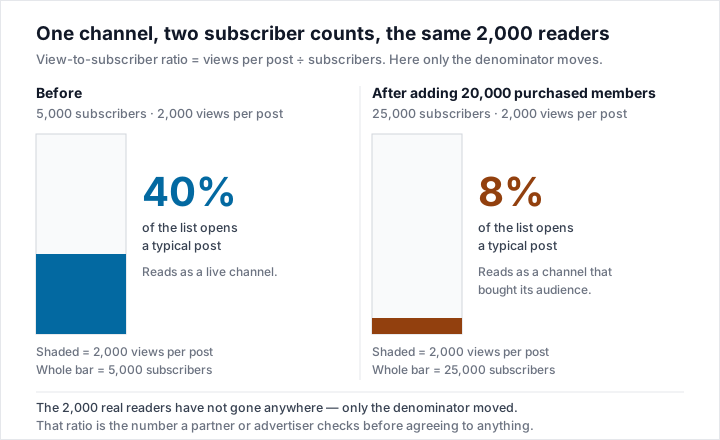
Worked example. A channel with 5,000 subscribers and 2,000 views per post has a 40% ratio. Add 20,000 purchased members and the ratio becomes 8%. The 2,000 readers have not gone anywhere, but the number that showed they existed has been diluted, and anyone evaluating the channel will now read it as a channel that bought its audience, because it is one.
Is there any case where paid members do something?
A narrow one. People use visible numbers as a shortcut, and a visitor who finds a few dozen subscribers under a channel’s name may take it for abandoned and leave. The psychology behind a visible follower count sets out the evidence for that effect.
The effect reaches as far as the next person who looks the channel over, and no further, because nothing downstream of that judgement reads a subscriber count. No individual post on Telegram is ranked or recommended; the one recommendation surface it has suggests whole channels, based on overlap between their subscriber bases. That is why a subscriber count behaves so differently here than on Instagram, and our guide to Telegram growth sets out the evidence.
Which puts a ceiling on any useful quantity. We have no basis for turning it into a multiplier and are not going to invent one, but you can work it out for your own channel: you know your view count, and you can calculate what a given number of non-reading subscribers does to views over subscribers before you buy anything. Past a modest number, a purchase raises the denominator, changes nothing that a reader experiences, and leaves a step in the growth graph that the channel’s owner, and anyone the owner shows the statistics to, will see.
Whether any of this breaks Telegram’s rules is answered too confidently in both directions; the restrictions page reads the Terms of Service line by line. The case against buying does not rest on a rule. It rests on the ratio above, on accounts that leave on their own, and on the fact that the only thing reliably delivered is a number.
What goes wrong most often?
- Buying to fix a decline. A falling view count is a signal that something changed. Adding members stops the subscriber number falling without touching the cause, and makes it impossible to tell afterwards whether anything you try works. Reviving an inactive channel covers diagnosing it.
- Not recording your numbers first. Once a batch arrives, views and subscribers are mixed and the before-and-after comparison is gone for good.
- Treating a refill as a fix. The replacements are the same kind of account as the originals and leave the same way, so a refill window is a recurring cost, not a cure.
- Paying by a route with no recourse. Providers in this market disappear and orders stall. Treat an unreversible payment as one you may lose entirely; outright fraud is covered in avoiding Telegram scams.
- Ordering for a channel with nothing on it. Members arriving at a channel with four posts make the emptiness more conspicuous. Growing a channel from zero has the sequence that produces readers.
For judging whoever is selling the tiers, the panel buyer’s guide has a Telegram section on what a higher price does and does not buy.
Disclosure: Novamya is published by Utta, which also builds and maintains websites for SMMLaunch and AdderPanel. Links to those panels are marked as sponsored. We do not accept payment for coverage or ratings — how this works.
Keep reading
Telegram Growth
What a Telegram Post’s View Count Actually Does
We read 430 public Telegram channels three times in one night and again four days later. A post under a day old had a little…
12 min read
Telegram Growth
How to Grow a Telegram Channel from Zero
A practical route from no subscribers to a channel that grows on its own — picking the format, being findable, earning forwards…
18 min read
Telegram Growth
What Are Telegram Premium Members and Why Do They Cost More?
Accounts with a paid Telegram subscription and a badge you can check. On 2 October 2026, 11 panels listed them at a median…
10 min read

Telegram Growth
Can You See Who Viewed Your Telegram Post? Surface by Surface
Channel posts give a number and never a name. Small groups, private chats and stories each show something different, for a…
8 min read