What Are Telegram Premium Members and Why Do They Cost More?
Accounts with a paid Telegram subscription and a badge you can check. On 2 October 2026, 11 panels listed them at a median 10.25× the ordinary-member price.
Telegram Premium members are accounts that hold Telegram’s paid subscription, marked by a star badge anyone can see. Panels price them higher, usually explained by scarcity and a badge buyers can check. How much higher, we measured: on 2 October 2026, the 11 public panels we read that list both kinds asked a median 10.25 times their ordinary-member price.
Everywhere else in the member market, “real”, “active” and “high quality” describe states nobody outside the panel can inspect. Premium is a claim you can confirm by opening a member list. It does not tell you whether the accounts will ever read a post, and most of the confusion about this tier comes from treating the first as evidence of the second.
What Telegram Premium is
Telegram Premium is a paid subscription tier. Telegram documents the features on its own Premium FAQ; the ones that matter for this discussion are the visible badge next to the account name, larger upload limits, custom emoji and reactions, and the ability to boost a channel.
The badge is the commercially relevant part. It is rendered next to the username everywhere the account appears, including in a channel’s member list. Holding the subscription yourself is a different question, covered in what Premium changes for channel owners.
How much more do panels charge for Premium members?
About ten times as much, at the median. We used the three public catalogue captures of fifteen SMM panels behind our panel price survey (2 September, 13 September and 2 October 2026) and sorted every USD Telegram member listing into Premium, where the name says so, and ordinary, where neither name nor category heading does; ambiguous listings were dropped. Inside each panel we divided the median Premium price per 1,000 by the median ordinary price, so a panel that is dear across the board does not count as a Premium effect, and took the median of those ratios.
| Catalogue read | Panels listing both | Premium / ordinary listings | Median ratio | Range across panels | Without the publisher’s two panels |
|---|---|---|---|---|---|
| 2 September 2026 | 11 | 1,247 / 969 | 11.25× | 6.83× to 50.31× | 11.67× (9 panels) |
| 13 September 2026 | 11 | 1,272 / 1,019 | 11.42× | 6.15× to 48.3× | 11.67× (9 panels) |
| 2 October 2026 | 11 | 1,306 / 1,020 | 10.25× | 6.35× to 55.2× | 10.91× (9 panels) |
The ratio was above 1 in all 11 panels on all three dates. Two of them, smmlaunch.com and adderpanel.com, are operated by the company that publishes Novamya; both sat at 7.74× on 2 October, below the median.
Speed, “quality” wording and guarantee terms are not held constant, so part of the gap may be other differences between listings. These are listed prices, not paid ones: we placed no order. Matching listings stating the same number of days in the same panel gives a median 12.94× across 57 groups in 11 panels, 56 of them above 1. That is a robustness check, not a like-for-like match: in Premium listings the days often mean how long the Premium lasts, elsewhere a non-drop or refill period.
What “days premium” in a listing name tells you
Of the 1,306 Premium listings on 2 October, 558 put a number of days on the Premium itself: “[30 Days Premium]”, “[180 Days Premium]”, “20 Days Premium Members”. That is what the listings say, not something we verified on any account; taken at its word, the badge is sold as lasting a set period.
So ask the seller what happens when the stated period ends: does the account stay as an ordinary member, leave, or fall under the refill terms? Those are often a separate, shorter number in the same name: one 2 October listing reads “30 Days Premium Members … 7 Days Non Drop – 7 Days Refill”. What refill guarantees actually promise covers that second number.
The ratios come from premium-members.py, which writes premium-members-stats.json; both are in the published survey data beside the raw catalogue pages.
Why they cost more
Three reasons are usually given; the measured prices do not settle the first.
The subscription is a cost. Premium is a paid tier, so the badge is usually read as a cost someone carries. The listed prices cannot settle that. On 2 October the median Premium listing ranged from $4.51 per 1,000 at one panel to $21.00 at another, at most about two cents an account. A price that size cannot tell a buyer how the Premium status on an account was obtained or how long it lasts; that is what the “days premium” wording above, and the questions it raises, are for.
Supply is smaller. Premium accounts are a fraction of all Telegram accounts, so the pool a provider can draw from is much shallower than for ordinary members.
The tier signals quality even when it does not deliver it. Because “Premium” is the most expensive line on the price list, buyers read it as the best product. Some of the gap is that association rather than any difference in how the accounts behave.
What you actually get
A member list that survives inspection
This is the honest core of the value. When someone evaluates a channel — a potential cross-promotion partner, an advertiser, a first-time visitor who taps through to the members — a list of accounts with no photos, no usernames and no badges reads as purchased in about two seconds. A list containing recognisably normal accounts, some with Premium badges, does not.
For a channel nobody evaluates, the tenfold price buys nothing a cheaper tier would not.
Channel boosts
Premium users can boost a channel, and boosts unlock features for the channel owner: custom reactions, the ability to post Stories, custom backgrounds, and similar. Boosts are separate from membership — a Premium account subscribing to your channel does not boost it; boosting is a deliberate action its holder takes — but only Premium accounts can boost, so the two are related. how Telegram boost levels work covers what the boost levels unlock.
If your actual goal is boosts rather than subscriber count, buying boosts directly is more efficient than buying Premium members and hoping.
Longer survival: claimed, not measured
Premium members are often said to stay longer than the cheapest tiers. We have not measured that, and the listings counsel caution: 558 of the 1,306 Premium listings on 2 October put a fixed number of days on the Premium itself, and a subscription that ends takes the badge with it.
What you do not get
This is the part the price tag implies and the product does not deliver.
Engagement. A Premium account that was added to your channel by a service is exactly as unlikely to open your posts as an ordinary one. The subscription describes the account’s billing status, not its owner’s interest in your subject. If your view counts do not move after buying Premium members, that is the expected outcome, not a defect.
Any distribution advantage. Telegram has no per-post ranking that reads your member composition and shows a post to more people. There is no feed of posts to be promoted in. Nor does the composition help with the one recommendation surface Telegram does document: its similar-channels endpoint selects on overlap between subscriber bases, so what matters there is which other channels your subscribers read, not what tier they were sold as. Otherwise a channel becomes more discoverable by being linked, forwarded or searched for. See the Telegram growth guide for how distribution actually works.
Protection from anything. Paying ten times as much per member does not make a channel less likely to be restricted. Enforcement responds to reported content and to spam behaviour, not to the price tier of your subscriber list. Does buying members get your channel restricted? covers what is actually known here.
When Premium is the rational choice
Narrowly, and it is worth being specific rather than diplomatic.
- Your channel is about to be evaluated by someone whose opinion has money attached. An advertiser, a partner, a client. The member list will be looked at.
- You need boosts for a specific channel feature, and you are buying members as the route to them. Check whether boosts can be bought directly first; usually they can, and more cheaply.
- Your audience is unusually sophisticated and will open the member list before trusting the channel.
Cases where it is not rational:
- You want more people to read your posts. Buy advertising, or a placement in a real channel. Members of any tier will not do this.
- You want the number to look bigger and nobody is inspecting the list. The cheaper tiers produce an identical number for roughly a tenth of the price.
- You are hoping Premium members are somehow “safer”. They are not; there is no safety property on offer.
The ratio problem does not go away
The view-to-subscriber arithmetic set out in the guide to real, fake and targeted members applies here at a higher price. Ten thousand Premium members added to a channel with 2,000 views per post produce the same ratio collapse as ten thousand of any other kind — at around ten times the cost.
If the reason you are buying is that the channel looks empty, the quantity that solves that problem is much smaller than the quantity most people buy. Enough that a visitor does not bounce; not so much that the arithmetic gives you away.
How to tell if an account has Telegram Premium
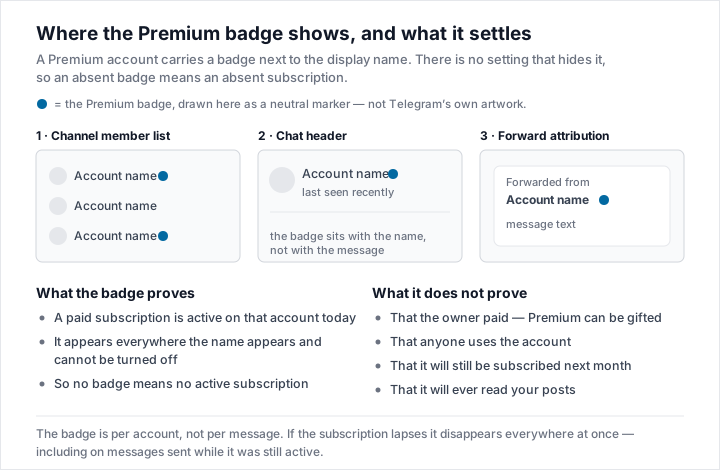
A Telegram Premium account carries a small badge — a stylised star — immediately after the display name. It appears everywhere the name appears: in a chat header, in a group or channel member list, in the forward attribution line on a message, and in the account’s own profile. There is no setting that hides it, so if the badge is absent, the subscription is absent.
Three things are worth knowing before you rely on the check.
- The badge is per-account, not per-message. Someone who lets their subscription lapse loses it everywhere at once, including retroactively on messages they sent while subscribed.
- Some Premium features are visible without the badge being the reason. Animated emoji, larger uploads and custom reactions all come with Premium, but seeing them in a chat only tells you that someone in it is subscribed.
- A gift counts. Telegram Premium can be given by another user, so the badge proves a subscription is active, not that the person paid for it themselves.
That last point is why the badge is useful for verifying a purchase and useless for judging a person. It tells you a subscription exists on that account today. It says nothing about who the account belongs to, whether it is used, or whether it will still be subscribed next month.
How to verify what you received
Unusually for this market, you can check.
- Before ordering, note how many days of Premium the listing states, if any.
- Open the channel’s member list after delivery and look for the badge. Sample thirty or forty accounts rather than the first five, which providers sometimes seed.
- Check again after 30 and 60 days, and after any period the listing named. A badge may be gone by then; if the listing said so, that is the product as described.
If a provider sells “Premium members” and the badges are not there at delivery, that is not a quality dispute — it is a straightforward failure to deliver the described product, and it is one of the few claims in this industry you can prove.
The broader point
Premium members are one of the few products in this market where the thing sold is the thing you can check. That is a genuine improvement, and it is worth recognising.
It is not the same as being useful. A verifiable badge on an account that will never read your channel is a verifiable badge on an account that will never read your channel. The question to answer before buying is not “are these better?” — on the one property you can check, they are — but “better at what, for how long, and does that matter to me?”
Disclosure: Novamya is published by Utta, which also builds and maintains websites for SMMLaunch and AdderPanel. Links to those panels are marked as sponsored. We do not accept payment for coverage or ratings — how this works.
Keep reading
Telegram Growth
What a Telegram Post’s View Count Actually Does
We read 430 public Telegram channels three times in one night and again four days later. A post under a day old had a little…
12 min read
Telegram Growth
How to Grow a Telegram Channel from Zero
A practical route from no subscribers to a channel that grows on its own — picking the format, being findable, earning forwards…
18 min read
Telegram Growth
Telegram Members Explained: Real, Fake and Targeted Tiers
What "real", "fake", "HQ", "targeted" and "non-drop" Telegram members literally are, what 12 public panel catalogues list and…
15 min read

Telegram Growth
Can You See Who Viewed Your Telegram Post? Surface by Surface
Channel posts give a number and never a name. Small groups, private chats and stories each show something different, for a…
8 min read