What Instagram Reach Means, and Why Yours Dropped
Reach is decided per post, not per account. What the number counts, why it falls, and which of the usual explanations are wrong.
Reach is the number most people watch and the one most misexplained. A drop produces a predictable set of theories — the algorithm changed, the account is shadowbanned, hashtags stopped working — and almost none of them survive contact with how distribution actually works.
This page covers what reach counts, what moves it, and what does not.
The short version
Reach counts unique accounts that saw a post. It is decided per post, not per account: every post is shown to a small sample, measured, then expanded or stopped. That means reach can swing enormously between consecutive posts on a healthy account, and it means a drop is usually about a specific post’s performance or about audience fit — not about a penalty. Hashtags are not named anywhere in Instagram’s own description of what ranks a post. Follower count is named exactly once, under Reels, and nowhere else.
What “accounts reached” means on Instagram
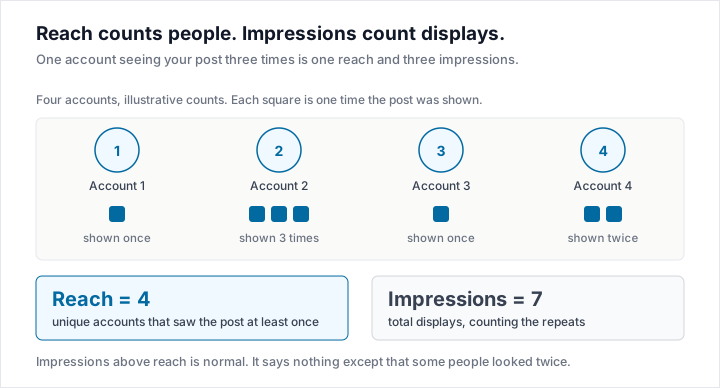
Reach — labelled “accounts reached” in Instagram Insights — is the number of unique accounts that saw your post at least once. One person who sees it five times counts once. It is a headcount, not a view count, and that single property is what separates it from every other number on the same screen.
Reach and views — and the number that used to sit between them
Instagram reports two figures for how far a post travelled. Until April 2025 it reported three, and most writing on the subject has not noticed.
| Metric | Meta’s definition | Status |
|---|---|---|
| Reach | “The number of unique accounts that have seen your content, at least once, including in ads” | Current |
| Views | “The number of times your content was played or displayed” — across reels, posts and stories | Current; took over from impressions |
| Impressions | Total displays, counting repeats | Deprecated for all API versions on 21 April 2025 |
Those definitions are Meta’s own words, from the Instagram Platform insights reference, which is also where the deprecation date is recorded.
The swap is worth more than a renaming usually is, for two reasons.
The first is that views is not impressions with a new label on it. Impressions counted displays. Views counts plays or displays and is applied across reels, posts and stories, which are surfaces where being played and being displayed are not the same event. A 2024 impressions figure and a 2026 views figure are two definitions, and nothing in the interface tells you that when you put them in the same spreadsheet.
The second is a test you can run on anything else you read. An article published this year that explains the difference between reach and impressions as though both numbers are on your screen was not checked against the platform before publication. This page failed that test until today, which is the correction at the top.
What survives the change is the property that made reach the number worth watching. One account seeing your post three times is one reach and three views: reach is a headcount, views is an event count, and the headcount is the honest one because it counts people rather than occasions. Engagement rate covers why dividing by reach rather than by followers changes what the ratio means.
How reach is decided
When you publish, Instagram shows the post to a sample of accounts and watches what they do — whether they stop scrolling, watch to the end, save it, share it, or visit your profile. That response feeds a prediction about how a wider audience would react, and the prediction decides whether distribution expands.
Instagram’s own account of this is more concrete than the industry’s. Its ranking explainer opens by saying that “Instagram doesn’t have a singular algorithm that oversees what people do and don’t see on the app” — Feed, Stories, Explore and Reels are ranked by separate systems with separate inputs — and for Feed it names the five interactions it looks at most closely: how likely you are to spend a few seconds on a post, comment on it, like it, share it, and tap on the profile photo Instagram Ranking Explained. Two things are worth taking from that sentence. It is unranked — liking and sharing sit in it as equals, so any hierarchy you read anywhere, including on this site, is somebody’s inference. And the first item on it is spending a few seconds on the post, which is the cheapest of the five to earn and the one every piece of advice further down this page is ultimately about.
One qualification, because the blanket version of this claim is wrong and this page has made it before. Follower count does appear once in Instagram’s list: under Reels, in the information it considers about the person who posted, it names popularity signals including how many followers the account has. It appears nowhere in the Feed, Stories or Explore descriptions. So “followers do not affect reach” is very nearly true rather than exactly true, and the exception happens to sit on the surface most people are trying to grow.
Three consequences follow, and they explain most reach confusion:
- Reach is per post. Not per account, not a level you reach and hold. Two posts published a day apart can differ by an order of magnitude on an account where nothing has changed.
- Your followers are eligible, not guaranteed. If the initial sample responds poorly, the post is shown to a fraction of your own audience. This is why reach can sit far below follower count without anything being wrong with the account.
- The sample is drawn from the audience the system associates with you. If that association is wrong, every post is tested on the wrong people and underperforms regardless of quality.
Why reach drops
In rough order of how often it is actually the cause.
The post was weaker
The dullest explanation and usually the right one. Reach responds to the first few seconds, so a weaker opening produces a worse sample response and a smaller expansion. Compare the retention or the early interaction on the low-reach post against your good ones before looking for anything more elaborate.
Audience fit drifted
If you changed subject, or a viral post brought in followers who wanted something you do not usually make, the system’s model of your audience is now wrong. Every subsequent post is tested on people with no interest in it.
This is the mechanism behind the common and demoralising pattern where a big post is followed by weeks of poor reach. The post did not “burn” anything; it changed who the system thinks you are for. Why followers drop covers the churn side of the same event.
Purchased followers
Here the honest version is narrower than the usual one, so it is worth separating what is documented from what is inferred. Instagram does not publish an engagement-rate metric at all: the insights reference reports counts — accounts engaged, total interactions, likes, comments, shares, saves, reach, views — and no rate and no formula anywhere among them. “Your engagement rate falls and the algorithm reads it” is therefore our arithmetic, not a platform reading.
What can be said from Instagram’s own documentation is smaller and still sufficient. Every signal it names is something a viewer does — pausing on the post, commenting, liking, sharing, tapping the profile. Purchased accounts do none of them, so they add nothing to any prediction while adding to every denominator a human or an audit tool computes about you. The mechanism is arithmetic, not punishment. The Instagram followers guide works through it.
Posting rate
Posting far more often splits the same audience attention across more posts. Per-post reach falls even when total reach rises. Whether that is a problem depends on which number you are being judged on.
Seasonality and competition
Your post competes against everything else published that day. Reach varies with the calendar in ways that have nothing to do with you.
Explanations that are usually wrong
“I’ve been shadowbanned.” Something like the mechanism does exist, it is documented, and — this is the part nobody mentions — it is visible to you in the app. Instagram’s ranking explainer states that content breaching its Recommendation Guidelines may not be shown in Explore, Reels or Search while remaining on the platform, that repeated breaches can make an account temporarily ineligible for recommendation, and that Account Status exists so an account can see whether its content is eligible and appeal the decision. So before assuming a secret penalty, open Account Status and read it. Then check whether reach fell on every post or on specific ones: a per-post pattern is ordinary distribution rather than a sanction, and a sanction would be sitting in a screen with your name on it.
“Instagram is throttling me to sell ads.” There is no evidence for this and it does not follow: the platform’s incentive is to show people content they engage with, since that is what keeps them there to see ads at all.
“Hashtags stopped working.” Hashtags are not named anywhere in Instagram’s description of what ranks Feed, Stories, Explore or Reels. Those lists cover your activity, your history with the account, information about the post and information about the person who posted. Absence from a summary is not proof that something does nothing, and we are not going to claim more than that — but it is the closest thing to evidence available, and it points the opposite way from how hashtags are usually sold. If reach depends on them, that dependency was the fragile part.
“The algorithm changed last week.” It changes continuously and without announcement, and no observation from a single account can distinguish a real change from ordinary sampling variance. Anyone quoting a specific recent change with confidence is guessing — see what changed in platform policy, and what did not.
What actually moves reach
- The first two seconds. Everything downstream is conditional on not being scrolled past. This is the highest-return thing to work on and it is almost always where the loss is.
- Saves and shares. They cost the viewer something, so they are weighted heavily. Making content worth saving is the most reliably improvable signal available. Which interactions carry the weight covers the hierarchy.
- Subject coherence. Protecting the system’s model of your audience is protecting your reach. This is the argument against chasing off-topic virality.
- Format. Different surfaces have different distribution ceilings, and they change over time. Test rather than assume.
- Not adding dead followers. The cheapest reach protection there is.
Reading your own reach
Two habits make the number useful instead of alarming.
Compare at equal age and in batches. A single post’s reach is dominated by sampling noise. Ten posts in a format tell you something; one tells you nothing.
Watch the follower/non-follower split. Instagram reports it. A rising non-follower share means the system is testing you more widely, which is the leading indicator of growth — and it can rise while total reach is flat. Profile visits and Explore reach covers what happens after a non-follower sees you.
The step nobody takes: write down your median reach per format each month. Reach feels like it is collapsing far more often than it is, and a median from three months ago settles most of those arguments in about ten seconds.
The mechanics here are shared across every platform with a recommendation feed; our guide to social media growth covers the general model, and the Telegram guide covers the one large platform where none of this applies, because nothing there ranks an individual post — the only thing Telegram recommends is whole channels, on overlap between subscriber bases.
Frequently asked questions
What is the difference between reach and views on Instagram?
Reach counts unique accounts that saw the post; views counts the times it was played or displayed. One account seeing a post three times is one reach and three views. Impressions, the metric this comparison used to be drawn with, was deprecated across all Instagram API versions on 21 April 2025 — if you are reading an explainer that still contrasts reach with impressions, it has not been checked since.
Why is my Instagram reach so low compared to my follower count?
Followers make you eligible for distribution, not entitled to it. Reach is decided per post, and the sample-then-expand picture people use to explain that is a model inferred from observed behaviour, not something Meta documents. Reach below follower count is the normal case either way, not a fault.
Do hashtags increase reach?
Very little, as far as anyone outside the company can tell. Hashtags are not named in Instagram’s own description of what ranks Feed, Explore or Reels, which is not proof they do nothing but is the only evidence there is. If reach depends on hashtags, that dependency is the fragile part of the strategy.
Why did my reach drop after a viral post?
A post that reached far outside your usual audience changes who the system associates you with. Subsequent posts are then tested on people with no interest in your normal content. Nothing was burned or penalised; the audience model moved.
Am I shadowbanned?
Check Account Status in the app before assuming anything; Instagram built it precisely so that limited eligibility is visible and appealable rather than secret. Distribution can be restricted for content that breaches the Recommendation Guidelines, but it responds to content and it is disclosed. Then check whether reach fell on every post or on specific ones — a per-post pattern is ordinary distribution.
Keep reading
Social Media Growth
What 15 Public SMM Panel Catalogues Listed, and What Changed Eleven Days Later
Fifteen public SMM panel catalogues, each read inside a twelve-second window on 2 September 2026 and again on 13 September…
24 min read
Social Media Growth
76 SMM Panels, One Piece of Software
We read the public pages of 84 SMM panels in one thirteen-minute window. Of the 76 that answered, 54 run the same vendor's…
8 min read
Social Media Growth
What Is an SMM Panel and How Does It Work?
Panels are reseller storefronts sitting on top of a much smaller number of suppliers. That structure explains almost everything…
17 min read
Social Media Growth
SMM Panel Buyer’s Guide: How to Choose One Safely
What to check before paying, which reassurances are worthless, how to set the delivery so the result is not obvious, and the…
17 min read